Submitted by Jules W
Welcome back to the mystery!
Hopefully, the previous blog highlighting the enormity of the community here in WW1 has whetted your appetite for more?
In this post, the soldiers who lived here will tell their story, maybe one of them was in the postcard picture from last time, or was asleep in one of the huts when the shutter clicked, or walking along Chyngton Lane?
As mentioned before, the internet is a marvellous invention, it facilitates education and research. With gathering momentum, museums, galleries, regiments and associations have digitalised much of the wealth of documents in their care thus giving us, the public, a window into the past. We can read the actual words of men who stood at the top of the hill, near South Barn, here in Seaford. Maybe they looked out to sea, fearful perhaps of what would await them, or perhaps stared longingly at the horizon yearning for home. They saw much the same view as we do today when we stand in their shoes and look to the horizon. [Almost – allowing for erosion!]
It is never possible to fully walk in another’s shoes of course, but with carefully researched information it is possible to create an interpretation of a soldier’s life in South Camp, merging detail from various sources, such as diaries, photographs, postcards, adverts, newspaper articles, sermons, it is possible to recreate a ‘generic soldier’ if there is such a thing!
The following is just that. So many thousands of men passed through Seaford from a wide variety of Battalions and Regiments that it is not possible to mention them all, that is for a military historian to do. The aim in these blogs is to raise awareness of the part that Seaford played in both world wars, to be proud that it was host to thousands of men, proud that it welcomed them. Over 280 lie in Seaford Cemetery, many thousands more lie in battlefield cemeteries in countries such as Egypt, Palestine, Belgium, France. Some have no known grave. Approximately 50% made it home, many of those men injured, both in body and mind, some unable to provide for their families through work.
A ‘soldier of the 36th Ulster Regiment’ 1915
The 36th Ulster Division filled the whole of South Camp, in fact, according to Rev John Pollock ‘there were something like 20,000 men at Seaford and a street row was unheard of.’ We get a sense of the men when he reports in Belfast that ‘The men of the Ulster Division were not ashamed to march along the esplanade singing in full chorus, “Onward, Christian soldiers,” or “When the Roll is Called up Yonder I’ll be there!” he also tells us that there were so many of them wanting to go to Church that ‘on one occasion that scores were turned away’. Whilst this gives us a sense from one perspective, was this really the reality for the soldier’s stationed here? An Ulster soldier photographed his time here and later in The Somme, George Hackney’s remarkable photographs and snippets from his diary tell us that South Camp was a mini town, it provided the men with support through the YMCA and the Churches, both in town and the Garrison Church. They lived here, so what did they actually do?
Let’s imagine a soldier, after a long journey from the camp at Ballykinler in Northern Ireland he gets off the train at Seaford Station – the noise is deafening, not only are men being unloaded, but horses, training equipment, supplies. Everything is slightly bewildering, officers are bellowing orders above the cacophony and eventually, they fall in for the march to camp. He’s quite euphoric through the tiredness of travel, the town people line the streets from the station, cheering. He feels welcome.
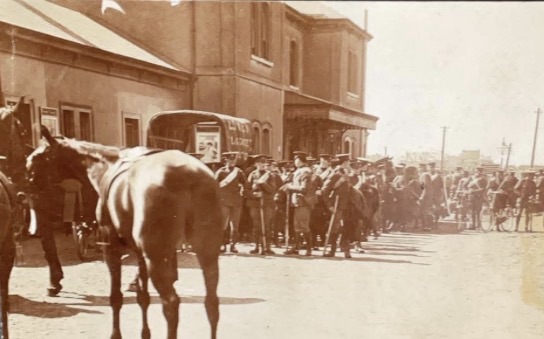
Kitchener will visit in July 1915 and state that ‘“your Division of Ulstermen is the finest I have yet seen”. King George V will inspect the troops in September 1915 just before they get deployed to France.

But returning to ‘Our Soldier’. This young man is with friends, men from home, his two older brothers already settled in camp, he hopes to find them, to put their minds at rest that he’s ok. That night he will set up in one of the huts, perhaps one in our ‘unassuming field’ mentioned in Blog 1. One hut would be very much like another – standard Army issue! His new home will resemble the huts in Ballykinler – 40 beds, closely packed, table in the middle, hooks on the wall – before the hour was out each soldier had claimed his space and scattered his belongings! He sits on the bed with its regulation blanket and covers, removes his two ounce a day ration of tobacco from his top pocket and expertly rolls it using one hand into a small cigarette, his lighter at the ready, the reassuring fizz as the paper ignites, he sits back and inhales deeply. He likes the comradeship here, coming from a family with 8 children, he’s used to sharing his space; for a few short minutes he thinks of home, his mother was deeply upset when he joined up, after all, he was only just 17 and shouldn’t even be in uniform. He will write later once he has explored the camp and Seaford and maybe buy a postcard from the YMCA.
Our lad has the confident swagger of youth, so far, news of fighting and the detail of war has been sporadic and the men still feel excited and ready to go. Of course, that won’t last once they arrive in France. But for the moment, the town that is South Camp will provide him with, boxing matches, football matches, spiritual guidance, the Temperance Society, which he will ignore, swimming in the Cuckmere River and off the beach, the esplanade which feels special and almost holiday like, the YMCA where he will thrash his pals at billiards. There will be moments of sheer pride: being part of the line up for Kitchener’s inspection and later for George V, which will be just before they leave for France. He will do well at rifle practice at the firing range on the beach and become a highly respected sniper in the trenches of Thiepval. So, for the moment, he will do his best, enjoy his friendships, the weather and the town!
The reality of the wafer-thin line between life and death will surface for our young man a month after arrival;
‘Our Wonderful Army had gone to war without any means of washing either the men or their clothes, and it fell to the lot of the RAMC [Royal Army Medical Corps] to improvise both’
One day, following the Bathing Parade in the Cuckmere River where the men had enjoyed cooling off in the water after a day of drill and training in the summer heat: splashing, shouting and generally messing around, as well as having a wash, one young chap from ‘Our’ man’s hut didn’t get out with the others – like many he couldn’t swim, suddenly out of his depth. A deep sadness would overcome Our Soldier and the pals in the hut as the empty bed stood testament to what would soon be a daily, if not hourly occurrence. The young recruit who died will have a full military funeral and lie in Seaford Cemetery. Our Soldier sent a postcard home to tell his mother this sad story, he posted it at the Post Office set up at the end of Chyngton Road, the postmark will say Chyngton Camp P.O. Seaford: After posting it Our Solider will join his friends at the cinema.
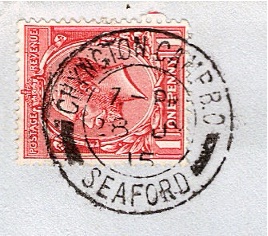
Our imaginary soldier will soon be shipped to France, he will initially survive the battles around Thiepval, and he will fine tune his excellent rifle skills, his bravado and swagger will lessen, he will now look much older than his 17 years. On July 1st, 1916, like so many of the 36th Ulster Regiment and his two brothers, he will go ‘over the top’, trusting that the weeks of deafening barrage against the German defences will have worked, at 7.28 a.m. he will hear the ear-splitting explosion that deafens the guns and spills debris 4,000 feet into the air, at what is now the Lochinvar Crater this will signal the start of one of the worst battles of WW1: The Somme. A battle that will not finish until November 1916.
By 9.00 a.m. the carnage of the battle is evident, the men, who had been told to walk across no-man’s land had been cut down in their thousands, [nearly 20,000 men die on Day 1 alone],
Our Soldier is no more.
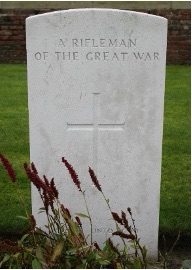
He may have a grave, such as this, hidden in the 150,000 British and Allied soldiers buried at The Somme. He may be only known by his inscription along with the 72,000 others who are the names of the missing at Thiepval. [see photo below] His mother will mourn not just the loss of Our Soldier, but of both his brothers. Her life will never be the same again.
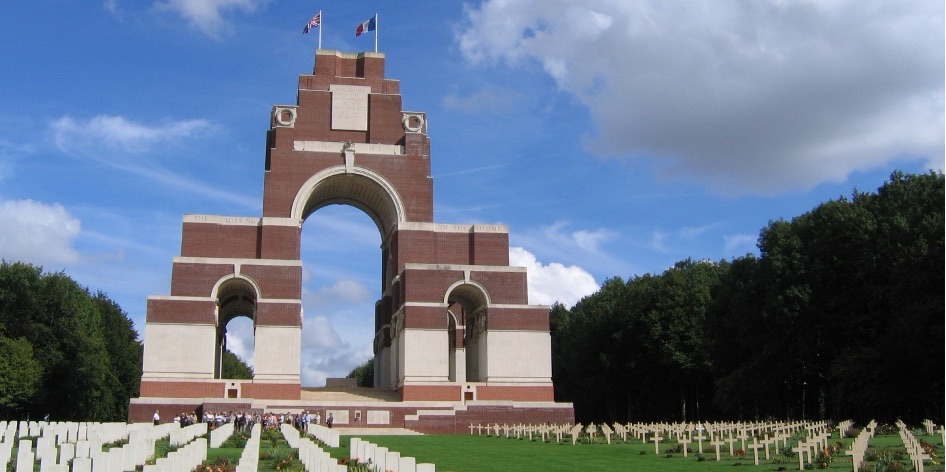
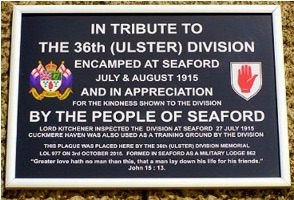
Our Soldier, like the thousands of other young men who came through Seaford, deserve their time here to be remembered, celebrated and commemorated. There is a plaque at Bönningstedt Promenade, but along with the countless other Battalions and Regiments, full commemoration of their lives should be where the camp was on Seaford Head, around our ‘unassuming field’ and today’s entry-point to Cuckmere Haven.
Coming next: Meet a WW1 Canadian Solider, how did his experience differ from The Ulster Regiment’s Soldier? Many were here in 1919 after the war ended, so did they visit other places, do other things?
Do you have a family connection to South or North Camp? Did one of your ancestors work /volunteer at the YMCA – Did one of your ancestors train here in WW1? Perhaps you have found some trace in your garden when digging? Let us know! Email celebratingseaford@gmail.com
This article is copyrighted, it may not be reproduced without the permission of the author.

 Celebrating Seaford