submitted by Jules W
What do a field, a mug and a postcard have in common? If this was a question on ITV’s ‘1% Club’ then perhaps a search for how many vowels they have, or which vowel is not evident, or letters in each noun, but this is not a test of IQ! It is a journey through time and place, a journey that was not initiated intentionally, but one of those quirks of fate that starts with a little nugget of interest and leads to something quite unexpected.
A snippet of information from a chance conversation with a Seafordonian started this journey, a throw away remark about ‘South Camp’ and WW1, all sparked by a conversation about an unassuming field and its place in the landscape. Speaking to a few others, like me, relative newcomers to the area, no-one could give me any further information or had, in many cases, even heard of it which seemed strange as it is such an important and significant part of the history here. Thankfully, the mine of information that is the Internet gave me enough relevant and confirmed information to answer some basic questions.
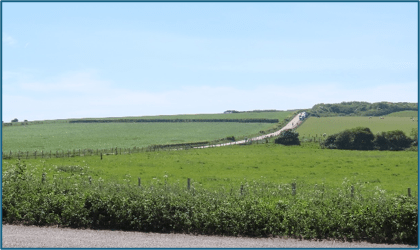
There is something rather gratifying about researching, it is also, on occasions, exceptionally frustrating, but taking the journey has a lot of satisfaction. There are some books, local history information and people who have previously researched it, but this was a journey for me to take and for me to discover. The history in this blog is my choice of the resources, I’m not writing a definitive guide to South Camp, nor am I an expert, but I have selected information to build this story. My sources have been wide ranging, and, as a historian, I always try to verify them for their validity.
At the end of it I was left feeling that this was a story that had to be told.
Today, the area is known by thousands of people worldwide as the entry point to the instantly recognizable Cuckmere Haven, Seven Sisters Cliffs and Coastguard’s Cottages. The fields that nestle either side of the bridleway up to South Hill Barn frame the area – visitors stop at frequent intervals to photograph the vista, the sheep and take selfies with the backdrop. It paints a picture of idyllic countryside, seemingly unchanged for centuries. In some ways a view taken for granted.
But so interesting to ponder on what lies beneath the surface.
South Camp was huge. A Canadian Army map[i] of the camp shows it running North down the hill from South Hill Barn and along Chyngton Lane, also running East and West either side of the Bridleway, along into the Golf Course with additional buildings and training ditches dotted across the area. There was also a smaller North Camp in the Blatchington Area.
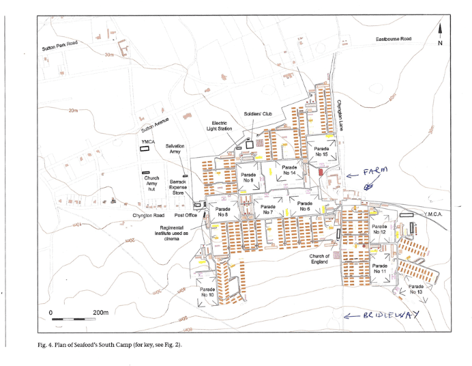
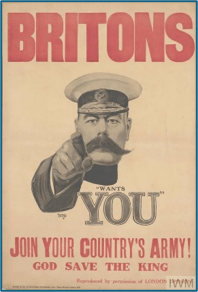
Yet, whilst that is interesting, it is the story and history of the people who populated both the camp and area that create the human interest here. The 1911 Census reported about 5,500 people living in Seaford, but a few years later with Kitchener’s call for men to join up, an additional 18,000 would join them! Remember, that after training, the soldiers would move on and more would arrive, then more, a rough estimate of 200,000 men passing through Seaford from the outbreak until 1919 when the last Canadians went home.
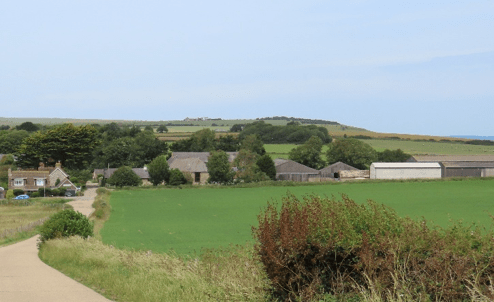
Picture this landscape then and now…
If you know the area, then search out the outline of the homes just before the farm, a picture postcard view of the English Countryside.
Now to the second part of the mystery,
For no particular reason one day a search on a well-known auction site bought up this wonderful postcard, it’s home in Canada, now with me in Seaford. It didn’t take long to recognise the view.

Search out, as above, the faint outline in the distance of the homes just before the farm, their shape unchanged, search out the men walking along Chyngton Lane towards Eastbourne Road, also unchanged today. We can place this postcard exactly in today’s landscape.
Dating from 1919 when the Canadian Troops were waiting to be sent home.
During this journey of discovery, the English, Welsh, Ulster, Scottish, West Indian and Canadian Troops have become alive in the landscape. These young men, here initially through a sense of adventure, the war would, after all, ‘be over by Christmas’, tempted by the King’s Shilling, perhaps a loyalty to the King; persuaded through the recruitment campaign to join, maybe here with their friends as part of ‘pals regiments’. For many, the first time on a train to get here, the first time seeing the sea, the first time out of their village. For the overseas troops, a long and hazardous journey across the ocean to a climate totally different from their own, a different culture even. Later trainees here because of conscription as the true cost of war, following The Somme had reduced the willing recruits. These young men’s worlds would be turned upside down and for many their lives would end on a battlefield in France, Belgium, Palestine, Egypt, or in Seaford before they even left for war.
Stand [safely!] at the base of the bridleway road at the end of Chyngton Way and face South Hill Barn, close your eyes and listen, block out the coaches, the cars and engage with the landscape. Laughter spills down the hill on the breeze mixed with the strong smell of tobacco, gunshots echo to the right in the distance on Seaford Head as troops rehearse capturing a trench; boots can be heard on the parade grounds somewhere to the right as the unmistakeable sound of a Sergeant Major drills the new recruits, mens’ chatter behind where you stand as they emerge from Chyngton Lane to go to the YMCA hut to play darts, write a letter home or to catch up with friends. Horses neigh in the background stabled somewhere in the camp…
Voices of men long since passed whose journeys will be revealed next time…
Do you have a family connection to South or North Camp? Did one of your ancestors work /volunteer at the YMCA – Did one of your ancestors train here in WW1? Perhaps you have found some trace in your garden when digging? Let us know! You can email celebratingseaford@gmail.com
Part 2 of this mystery to follow..
[i] Library and Archives Canada, Ottawa, Q4-54887, Series E-17, Vol. 21, File ‘21’ (21–27) 1916-C ‘Plans de camps’. Noted in Barber. L & Russell. J. Training For War, SUSSEX ARCHAEOLOGICAL COLLECTIONS 153 (2015), 191–201
This article is copyrighted, it may not be reproduced without the permission of the author.

 Celebrating Seaford