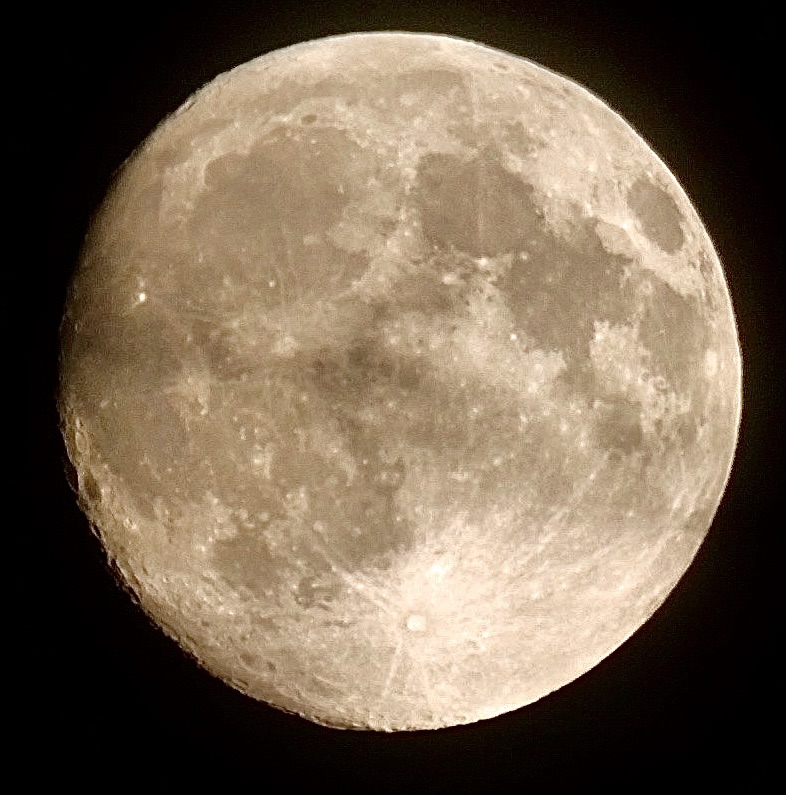
The Moon is our nearest neighbour in our Solar System. It was
formed about 4.5 billion years ago, soon after the Earth.
This beautiful celestial body is an average of 238,855 miles away from Earth and it takes 1.3 seconds for light to travel from the Moon to Earth.
The moon is an important part of our life, its gravity keeps Earth from wobbling too much on its axis, which stabilizes our climate and ensures consistent seasons. The Moon is mostly responsible for the tides on Earth due to the gravitational pull of the moon as Earth spins on its axis
You may be interested in more detailed information on our moon provided below by Chris Woodcock, President of the Sussex Sidewalk Astronomers Group.
‘Another set of moon phases has started, so I thought I’d share a few pointers to help others learn a bit more about our natural satellite.
Here, the first picture shows two well know and well observed craters.
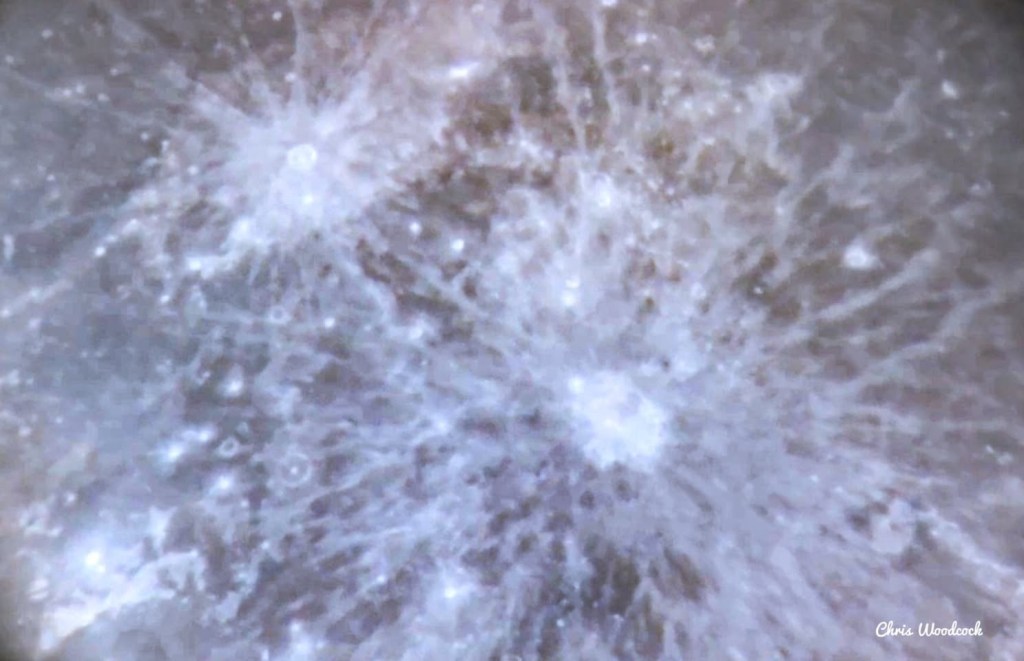
The small crater, upper left, is named Kepler, after Johannes Kepler, 1571-1630, who derived the three laws of Planetary Motion. It’s 32km in diameter. Lower right of Kepler is Copernicus. Probably the most observed crater of all, it’s 93km in diameter and nearly 4km deep. At its centre there are mountains that can be seen in small telescopes. The rays stretching out from the craters are called “rays” oddly enough. These are the remnants of materials thrown outward by the blasts that formed the craters millions of years ago. (I’ll do a bit of Cratering another time).
The second picture shows Mare, or Sea, Serinitatis. (The plain patch on the left).
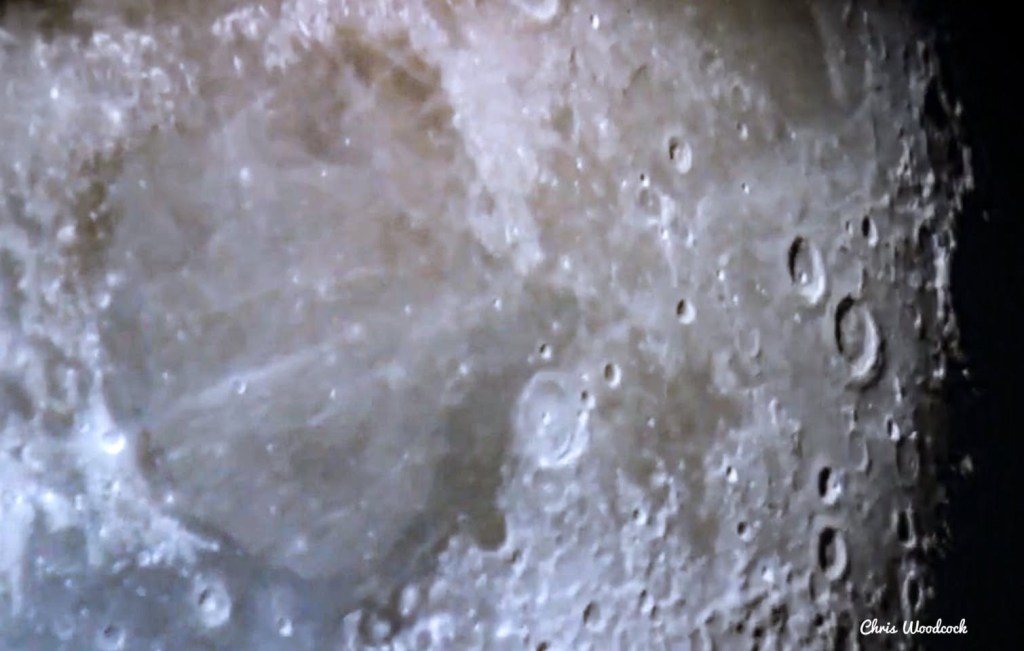
To the right of this Mare we can see a few nice craters including Posidonius on the Mare edge and Hercules and Atlas to the right of Posidonius.
The third picture shows Mare Tranquilitatis, the sea of Tranquility, where Apollo 11 landed in 1969 putting the first man on the moon. To the lower right of that in this pic is another Mare with a nice mountainous range surrounding it, Mare Crisium.

These are just a few of the hundreds of features we can see on the moon. As the phases progress over days we see something different each phase.
When we see the moon in phases, such as Crescent, Half moon or a Gibbous we see excellent detail thanks to the shadows caused by the sun light. During a full moon there is very little shadowing so detail isn’t that good, except for the dark Mare. By the way, this is pronounced Mar Ay.’
Chris is passionate about sharing his love for astronomy and is often out with his telescope showing the wonders of the dark sky to young and old alike. If you are part of a group, or school and would like Chris to come and give a talk and/or a tour of the night sky through his telescope then feel free to contact him via his Facebook page
Sussex Sidewalk Astronomers Facebook page
Alternatively contact Celebrating Seaford and we will pass on your details.
Chris does not charge as he feels everyone should have a chance to explore the beauty and wonder of the world of astronomy.

 Celebrating Seaford