Every year, as spring’s gentle blooms recede and summer’s warmth takes hold, people around the world turn their eyes to the sky to witness an ancient and wondrous event: the summer solstice. Steeped in both astronomical science and cultural tradition, the summer solstice marks the moment when the Earth, in its celestial dance around the sun, tilts closest toward its radiant star, bringing with it the longest day and the shortest night of the year.
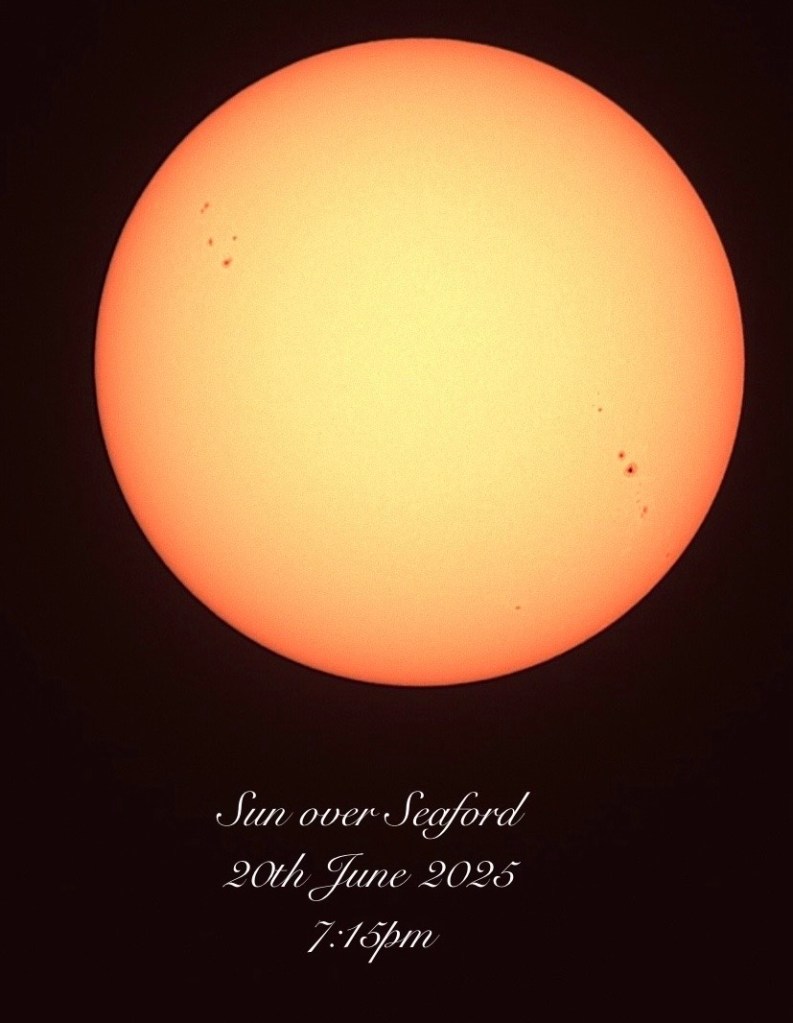
At its heart, the summer solstice is an astronomical event, occurring when one of Earth’s poles is tilted maximally toward the Sun. In the northern hemisphere, this usually falls on June 20th, 21st, or 22nd. This year the Summer Solstice occurs at 03:41 am BST Saturday 21st June. On this day, the Sun’s path across the sky reaches its highest and northernmost point, causing it to appear to stand still at noon before beginning its gradual return southward.
The summer solstice brings the longest stretch of daylight to regions north of the equator. In some locations, such as the Arctic Circle, the Sun does not set at all—resulting in the phenomenon known as the “Midnight Sun.” Meanwhile, areas at lower latitudes enjoy significantly extended daylight hours, making it a cherished time for outdoor activity and celebration.
The actual duration of daylight on the solstice varies with latitude. In Seaford on the 20th June 2025 the Sun rose at 4:43am and will be setting at 9:18pm
The summer solstice has been a time of awe and reverence for humans for millennia. In the absence of modern calendars, ancient peoples tracked the Sun’s movements to mark time and guide agricultural, social, and religious practices.
Perhaps the most famous solstice-aligned monument is Stonehenge in southern England. Massive stones, arranged in concentric circles, are precisely positioned so that the Sun rises directly above the Heel Stone on the summer solstice. Thousands gather at Stonehenge every June to witness the sunrise in much the same way as people did thousands of years ago. Similar megalithic structures, such as Newgrange in Ireland and the Temple of the Sun in Machu Picchu, Peru, demonstrate that solstice observance was a global phenomenon among ancient cultures.
Many civilizations saw the solstice as a powerful, even sacred, event. Ancient Egyptians aligned the construction of the Great Pyramids with the Sun’s movement, while early Greeks and Romans celebrated with feasts honouring deities like Apollo and Juno. In Scandinavian countries, solstice celebrations—known as Midsummer—were (and still are) marked with bonfires, dances, and rituals intended to bring good fortune, love, and a bountiful harvest.
While the specific meaning and customs of the summer solstice vary by region, the day’s universal themes are light, fertility, and renewal.
In many traditions, the solstice is imbued with magical qualities. Folklore suggests that plants harvested on this day possess heightened powers, while the boundary between the natural and supernatural worlds becomes thin. Shakespeare’s “A Midsummer Night’s Dream” famously draws on these associations, weaving a tale of enchantment and romance on this mystical night.
Today, the summer solstice inspires festivals, yoga gatherings, art installations, and scientific outreach worldwide.
The summer solstice, ancient and ever-new, remains a touchstone in humanity’s relationship with the cosmos. It is a day when science and spirit converge, inviting both reflection and revelry. Whether marked by solemn ritual, exuberant festivity, or quiet contemplation, the solstice reminds us of the enduring rhythms of nature and the preciousness of light. As the longest day unfolds, we are called to celebrate not only the sun’s generosity but also the limitless potential within ourselves and our communities.

 Celebrating Seaford