By Rodney Castleden
In 2014 a prehistoric industrial site was discovered, by chance and completely unexpectedly, right in the heart of Seaford. Ahead of redevelopment, the archaeologist Greg Priestley-Bell arrived with a team from Archaeology South East to excavate the Victorian school playground in Steyne Road. Behind the old school building was the former playground, which was to be redeveloped as a Sixth Form Centre. Under its thin layer of tarmac was a layer of clean brown silt, which in turn rested on the chalk bedrock. In the middle ages the site was just outside the town, at the western end of a large open field. The layer of brown silt represented redeposited soil carried down the slope by annual ploughing.
As is routine these days ahead of development, the Planning Office required a test pit to be dug, to be sure that no significant archaeology would be disturbed. In this case, there was no reason to suppose that anything at all would be found. But the test pit revealed that about three feet down in the silt there was a thin layer consisting of hundreds of waste flint flakes. It was a prehistoric tool factory, a completely unexpected focus of Neolithic industry in 4000-3000 BC.

The Sixth Form Centre during redevelopment.
When the site was fully excavated, the thin layer of flint flakes turned out to stretch right across the entire site; it consisted of thousands of worked flints, including some finished tools and some that had been broken during manufacture and discarded. The layer showed no sign of stopping at the property boundaries, and it is assumed the flint-working site continued for some distance further in all directions.

A beautifully finished arrowhead found at the axe factory site
Until he arrived in Sussex and met the County Archaeologist, Casper Johnson, Greg Priestley-Bell did not know about the axe hoard that was discovered in 1986 two hundred yards away in the High Street. The axe hoard was missing from the East Sussex Historic Environment Record, one of many oddities about the axes in a history reaching back to the time of their discovery decades before. Greg sensed that the High Street axes might be connected in some way with the Sixth Form Centre site. He thought it was possible that the axes had been made there. Found in Seaford and made in Seaford.
The Neolithic tool-makers who made the axes probably lived not far away, and the nearest Neolithic settlement that we know of was in the Fitzgerald Avenue area, a short walk away from the Sixth Form Centre.
As we saw in an earlier article, finding the axe hoard was an entirely separate discovery. Most finds of Neolithic stone axes are isolated ‘drops’ and they are usually found by chance, one at a time. So what happened in December 1986 – the discovery of fifteen neolithic axes all in one place – was remarkable.
Most of the flintwork at the factory site consisted of discarded flakes, chips rather than tools, but amongst the fragments were pieces of flint axes of the same size and design as the axes in the axe hoard. Another single axe, a broken reject, was found in a garden in Ashurst Road a hundred yards to the east – all of these axes had been made at the axe factory. We may now begin to see what the purpose of the axe hoard was – probably a consignment of tools ready for collection. Seaford Bay existed five thousand years ago, though the coastline would have been much further out to seaward. The factory could have been supplying axes not just for local use in the ‘Eastern Downs’ territory but for the regional trading network far beyond.
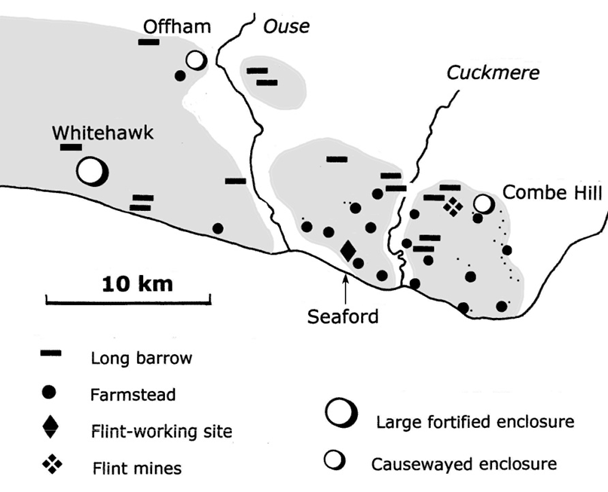
The Eastern Downs territory, 4000 – 2500 BC
When we map the Neolithic long barrows, the ceremonial enclosures, the farmsteads and the scatters of arrowheads (the small dots on the map above), we can see that the Downs were busy, both occupied and farmed. There would have been a steady demand for axes and a range of other flint tools, like the disc-shaped scrapers that were used as multi-purpose knives, So it is not surprising to find that the Seaford axe factory was in use for a very long time.
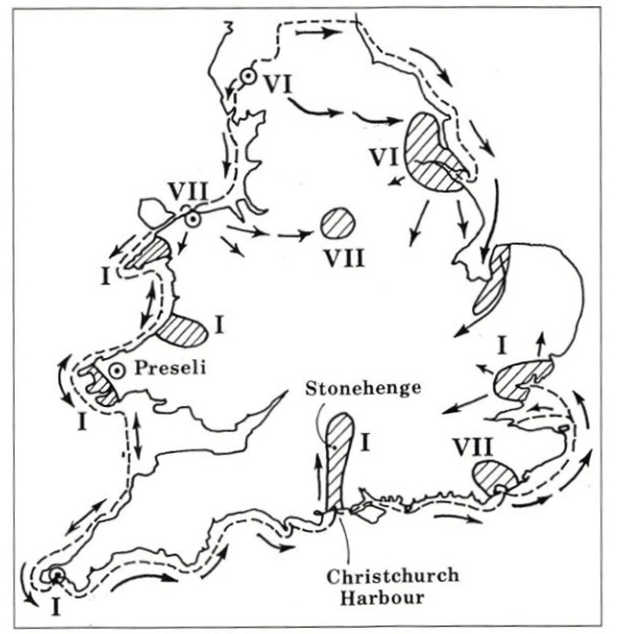
Findspots of exotic axes show where the trade routes were. Group VII axes found round Pevensey Bay came from the Graig Lwyd axe factory near Conwy in North Wales. Group I greenstone axes found round Cardigan Bay and in the Avon valley and Essex came from west Cornwall. The pattern adds up to a busy and well-organised trading system based on coastal navigation. Seaford Bay would have been on the Channel route.
Finds of exotic or foreign axes across England and Wales show that axes were traded both overland and by sea. There was a bay-hopping trading route running right along the Channel coast, and Seaford Bay may well have been one of the stopping places where commodities were exchanged. That being so, it is easy to see that a bag of fifteen axeheads might have been an ‘order’ awaiting collection by the crew of a visiting logboat. An order that for some reason was never collected.
For more information, read The Seaford Axe Hoard (£10 pb, 133 pages, 65 black and white illustrations). To order a copy, contact Rodney Castleden at Rookery Cottage, Blatchington Hill, Seaford BN25 2AJ, or email rodneycastleden35@gmail.com.
He will deliver free in Seaford.

 Celebrating Seaford