By Rodney Castleden
The town of Seaford had its beginnings quite late, after the Norman Conquest, as a port to serve Lewes. What was here at Seaford before 1066? Because there are several settlements in the area with Saxon names – Bishopstone, Blatchington, Sutton and Chyngton to name the nearest – it’s often assumed that Seaford too was a Saxon settlement. But it seems there was nobody living here at all before the Normans came. It was just open country in 1066, and it had been open country for hundreds of years before that.
But if we go back to much earlier times, we’ll find that there were people living and working here, long before the town existed.
The first evidence came in December 1986, when two workmen were digging a narrow trench down the High Street, ready to lay a gas main, when just outside Toy Town they broke into a pit containing some flint axes. The two workmen, David Brett and Frank Blackford, realised they had found something significant. It wasn’t buried treasure exactly but something they had never seen before. They carefully lifted the flint axes out one by one. There were fifteen of them altogether.
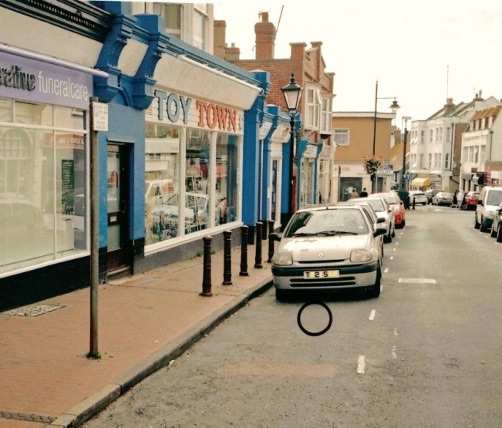
The County Archaeologist, Andrew Woodcock, arrived on the scene and identified them as Neolithic axes. He wondered whether there might be more and, without being asked, David and Frank obligingly re-opened the trench they had just backfilled all the way up the street to see if they had overlooked any, but there weren’t any more. They noticed that the axes were tightly packed together and they believed that meant they had originally been buried in a bag. They were probably right, and the bag had rotted away. The stone axes, each six or seven inches long, had been deliberately buried together, in a pit about two feet deep. And from the style of the axes this happened in the Neolithic, in 3000-4000 BC.

So, although there was no-one living in Seaford between the Roman occupation and the Norman Conquest, there had been people living here in the stone age, 5000 to 6000 years ago.
Small axe hoards consisting of two to eight axes were fairly common in southern England, but larger hoards were unusual.
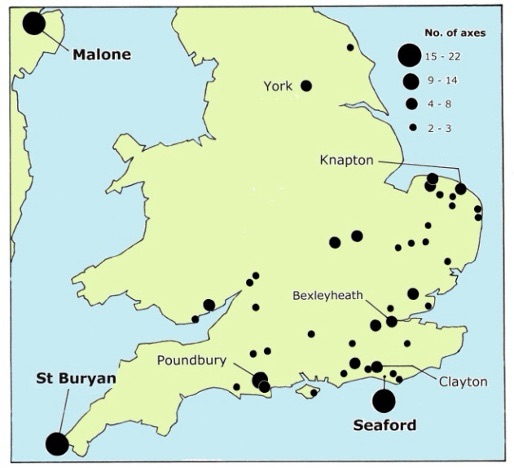
The biggest hoard of stone axes ever found in Britain is the hoard of 22 small axes found at St Buryan in Cornwall. This hoard is doubly unusual in consisting of ‘foreign’ axes imported from Brittany – again back in the Neolithic, at the same time as the Seaford hoard. But after St Buryan, the Seaford Axe Hoard is the largest hoard of stone axes ever found in Britain.
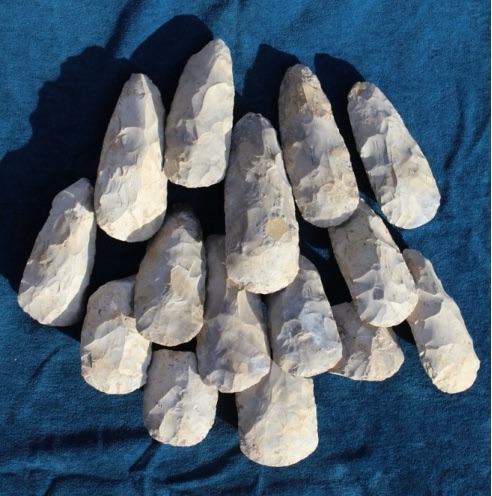
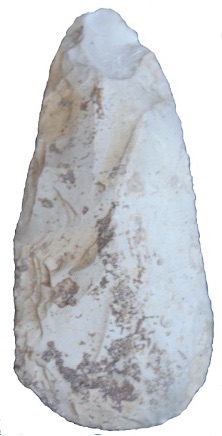
The hoard axes had been chipped and flaked to a point where they were perfectly serviceable as axe-heads. They could easily have been hafted, fitted into wooden handles, and used just as they were to chop down trees. The axes were not polished. Just a few axes made in the Seaford area were finished in this way. One, found in the Seaford area, was polished and turned into a perfect teardrop shape. It is displayed in Seaford Museum, like the axe hoard. It would have been someone’s prized possession.
The reason for burying the hoard is hard to reach. It involves exploring what was going on in the minds of stone age people, which is hard to do with any confidence. One possibility is that it was an offering to the gods, a sacrifice, a way of saying thank you for all the flint. Another is that hiding the axes in the ground was a way of keeping them safe. Maybe whoever buried the axes intended to come back later and dig them up, but for some reason didn’t. It is a mystery.
Back in 1986, Andrew Woodcock took the axes to his office in Lewes for safe-keeping. He had them professionally drawn by Alex Thompson with a view to publishing an academic paper about them, but he was overtaken by other work and the axes were put to one side. So now, instead of being buried and lost underground, they were shut in a cupboard in Southover and forgotten. You will have heard of history repeating itself; this was prehistory repeating itself.
Rescue came much later, when I was looking through the archive files at Seaford Museum and by chance found press cuttings from 1987 announcing the discovery of the hoard and 2002 correspondence between Andrew Woodcock and Sue Sutton, the Museum archivist. Then I realised that the axe hoard had been handed over to Seaford Museum, where it had disappeared again – for a third time. Through Andrew Woodcock, who was by then retired and living in Battle, I was able to trace Alex and her very accurate scale drawings of the axes. With the help of these drawings and a good deal of hunting round the Museum displays and stores, I was eventually able to track down and identify all of the axes and, with Chairman Kay Turvey’s approval, reunite them. In 2015 Alex Thompson and I formally published the hoard in the Sussex Archaeological Collections, as it should have been 35 years earlier. And now, at long last, the Seaford Axe Hoard is on display as it should be in Seaford Museum. A happy ending!
For more information, read The Seaford Axe Hoard (£10 pb, 133 pages, 65 black and white illustrations). For a copy, contact Rodney Castleden at Rookery Cottage, Blatchington Hill, Seaford BN25 2AJ, or email rodneycastleden35@gmail.com. He will deliver free in Seaford.

 Celebrating Seaford