Article by Rodney Castleden
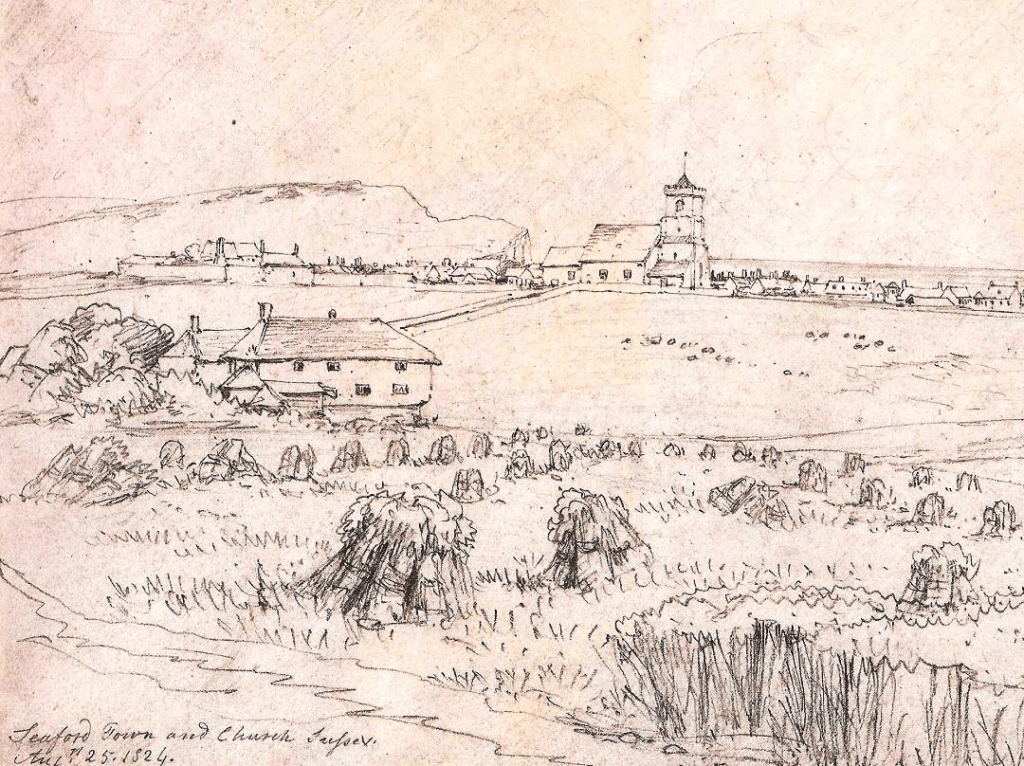
Two hundred years ago, an artist walked up Belgrave Road, which was then a road crossing open farmland, and opposite the end of Carlton Road he turned down the twitten to the right. This was an open field path, a right of way between the fields, Guard Ale to the east and Workhouse Laine to the west. He walked down some distance, about as far as where Salisbury Road now crosses the path. There, to get his view of the town and its setting, he set up his folding stool and got out his sketchbook.
His drawing shows St Leonard’s church and the town of Seaford on the next spur, with Seaford Head to the left in the distance. In the foreground is a cornfield, partly harvested, though there is no sign of any harvesters, though it was certainly drawn on a weekday (a Wednesday, in fact). In the bottom left hand corner is the field path, continuing down to the bottom of the valley. The bottom of this valley runs right across the middle of the picture, and it marks the parish boundary between Seaford and Blatchington. The Salts are over on the right hand edge. On the left is a substantial building the artist was particularly interested in; one can imagine that becoming a major feature of a finished painting. From its position, it can only have been the Workhouse.
The drawing is carefully labelled ‘Seaford Church and town, Sussex, Augst 25, 1824.’ But it is unsigned. So who drew it? The date is significant. John Constable exhibited his famous Hay Wain three years earlier, so this was the hey-day of one of the greatest English painters. But Sussex is certainly not what we think of as Constable country. Did he ever visit Seaford? Constable’s wife Maria had tuberculosis and he was advised to move her out of London to breathe cleaner air. In 1824 he found lodgings in Brighton for the family. While they stayed there, Constable walked extensively in both directions along the coast, sketching and painting small oil sketches of sea and sky in the lid of his paintbox. He didn’t paint any full-size paintings of Sussex, other than one of the Chain Pier.
There’s no other record of Constable’s visit to Seaford, but this one fine drawing is typical of his work. Earlier he visited the Lake District but he didn’t like it. His friend and biographer Charles Leslie said, ‘His nature was peculiarly social and could not feel satisfied with scenery that did not abound in human associations. He required villages, churches, farmhouses and cottages.’ How well that describes this picture. And how good it is to have rediscovered this lost Constable, and reinstated a surprising piece of Seaford’s heritage.
We must be grateful to Ben Franks for finding it online – in a museum in America!
Rodney Castleden

 Celebrating Seaford