By Rodney Castleden
From 1351 onwards, every town and village in England had to have stocks. They were the standard instruments of punishment for minor offences. The stocks were part of the texture of English village life in the late middle ages and early modern period, along with the ducking stool, the pillory and the whipping post. These were shaming punishments and they were popular among the judiciary, and considered preferable to imprisonment, which was not nearly as common as it is today. Now shaming punishments have disappeared, while imprisonment continues to escalate – at a huge cost.
The town of Seaford must have had its own stocks, but I’m not sure where they were. They may have been set up next to the pillory (in effect ‘standing-up’ stocks) and the pillory stood at the southern end of Broad Street on what is now the pavement in front of Crepes de la Crème and Clearwell Mobility. The present shop building replaced one of Seaford’s old pubs, The Old Tree Inn. The ‘tree’ in question was the pillory. Crouch Square, the market place, is another possible location for Seaford’s stocks.
Blatchington village, then separate from Seaford, had its own stocks, though like most others they have long since disappeared.
Stocks usually consisted of a pair of large wooden boards mounted one above the other in two stout posts set in the ground. The boards could be slid a short distance up and down in slots, and padlocked together in the middle. Some had a fixed lower board and an upper board that was hinged at one end and padlocked at the other. The inner edges had semi-circular ‘bites’ cut out to hold the victims’ ankles. Sometimes there was a third board to secure the wrists.
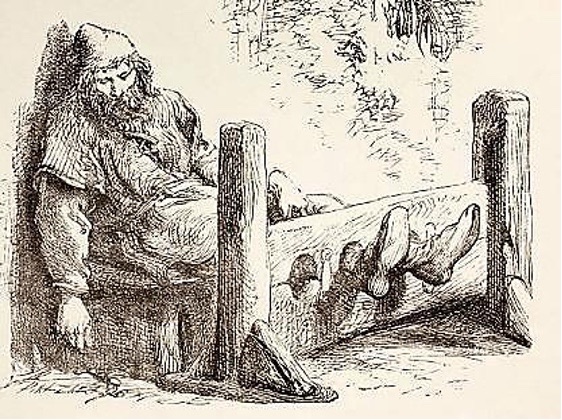
Many sets of stocks took two wrongdoers at a time while some, like those at Great Amwell, were designed to take three. The Statute of Labourers of 1351 ordered the use of stocks to punish ‘unruly artisans’, and required every town and village in England to set up stocks. Being put in the stocks was a standard punishment for drunkenness and a range of other minor offences such as resisting the constable and stealing firewood.
The stocks have often been portrayed as good-humoured, a bit of harmless fun in Merrie England, but being put in the stocks could be a serious matter. At the lighter end, you might be sentenced to a few hours, and fellow villagers might tickle your feet or jeer at you. At the heavy end, you might be left there for days, subjected to unpleasant verbal abuse and have things thrown at you, including stones. You might end up injured – or even dead from exposure. It was an open-ended punishment.
Stocks were in common use in England until the early nineteenth century. The Blatchington stocks were still in use during the Napoleonic Wars, when hundreds of soldiers were stationed at Blatchington Barracks. in 1897 Blatchington’s rector, Arthur Richardson, reported that he had been told a story about the Blatchington stocks, presumably by one of his older parishioners. A soldier was put in the stocks. A man came by and said, ‘Why, they can’t have put you in these stocks!’ ‘But they have,’ said the soldier. ‘But they can’t!’ said the other man. ‘But they have,’ said the soldier. And so on. This may be a story the parishioner had heard when young from his father or grandfather.
The stocks don’t exist any more, but where were they? Richardson’s informant told him they were down Blatchington Hill, below Star House, but on the west side of the street. They must have stood on indisputably public space, in other words on the road verge or bank between the road and the flint roadwall. Where was there enough space for this?
Recently the Council decided to clear the trees from an overgrown section of roadside verge in front of No 9 Blatchington Hill. Questions raised about the ownership of the verge made me go and have a close look at it. The dense vegetation covering the site concealed the fact that the flint wall running down the Hill is stepped back about three metres for a short distance in front of No 9. This unnoticed stepback is a long-established feature of the wall line. It is shown on the 1873 OS map, which predates the modern houses.
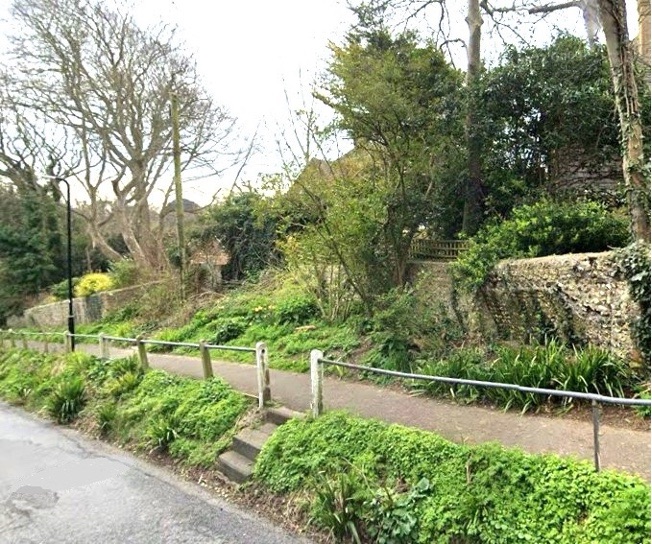
This is where the village stocks are most likely to have stood. The size of the plot is about right, and mounted here, on a bank above the sunken lane, they would have been conspicuous both from the pathway and the road itself. This spot, where some people now throw the unwanted remains of their fast food, may be the very place where their ancestors lobbed a tomato or an egg at a neighbour they disliked.
Rodney has written many books on Seaford and the surrounding area. A number of his books are listed at the end of the ‘Seaford’s Medieval Market Square’ article on this webpage. If you are interested in buying any of Rodney’s books, please contact Rodney either by email (rodneycastleden35@gmail.com) or by post (Rodney Castleden, Rookery Cottage, Blatchington Hill, BN25 2AJ). He will deliver copies to you anywhere in Seaford.

 Celebrating Seaford