Article kindly submitted by Seaford Museum and Heritage Society
Well, yes, no and maybe. Which war, anyway? The ‘lump of concrete’ in question is the Martello Tower that now stands on Seaford Esplanade. It’s not concrete of course, but brickwork later covered in stucco.
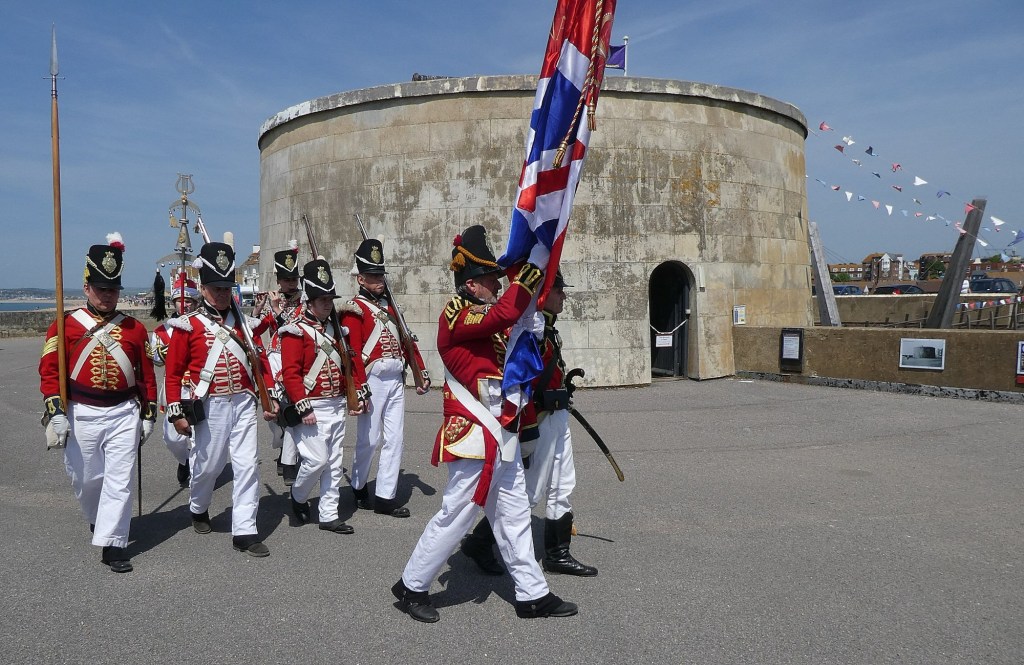
This photo was taken in May 2023 when the Tower was visited by His Majesty’s 1st Foot Re-enactors, with period uniforms and muskets.
All 103 Martello Towers were built in the late 18th and early 19th Centuries as a bit of a panic defence against the threat of invasion by Napoleonic France. At one point, an invasion force of over 120,000 soldiers waited on the northern coast of France.
Along the south coast from Folkestone to Seaford, and up the east coast to Aldeborough in Suffolk, Martello Towers – the design copied from defensive towers in Sardinia – were hastily erected to dissuade Napoleon from attacking. As it was, Seaford’s tower – number 74 and the most westerly completed – was not operational until around 1808, by which time Napoleon’s fleet had been defeated at Trafalgar and his attentions had shifted eastwards towards Russia.
The Tower would have been occupied in time of war by one officer and twenty four soldiers who would have manned the main gun and side armaments protected by a circular moat. Living conditions would have been cramped and primitive, but the Tower would only have been ‘locked down’ as the invasion was imminent. Between times, the soldiers were housed in lodgings in the town.
When completed, our Tower was topped by a 22 pound gun that could reach almost as far as Newhaven, and it’s worth remembering that there was a town battery of heavier guns roughly where the Causeway meets the Esplanade and another, smaller battery of guns to the east of the Tower. Our coastline was very well defended but thankfully, the defences were never fired in anger.
Few Martello Towers survive as well as Seaford’s which is one of only two or three regularly open to the public. Some other towers have been converted into private homes, some have been washed away, and some were used for target practice in the mid-19th Century when rifled artillery and explosive shells were being introduced.
Since being ‘retired’ and disposed of by the military, our Tower has been occupied by Customs and Excise officers (on at least one occasion serving as a lock-up for smugglers), signalling station, the Home Guard, tea rooms, a roller-skating rink, public slipper baths, amusement arcade, dance studio and much more. Until 1978, there was a six-roomed flat perched on the roof like a pie crust!
And for the past fifty years or so, the Martello Tower has been the home of Seaford Museum and Heritage Society, and open to the public.
If you are strolling along the Esplanade, it can be difficult to imagine what the seafront was like when the Tower was built. There was no roadway of course, and for the first fifty or sixty years of its existence, Seaford Martello Tower wasn’t marked on maps because it was a ‘sensitive’ military installation. Over time, the paved Esplanade was extended towards Splash Point and in 1935, the seaward half of the Tower’s open moat was covered over to allow strollers and holidaymakers an uninterrupted walkway along the seafront.
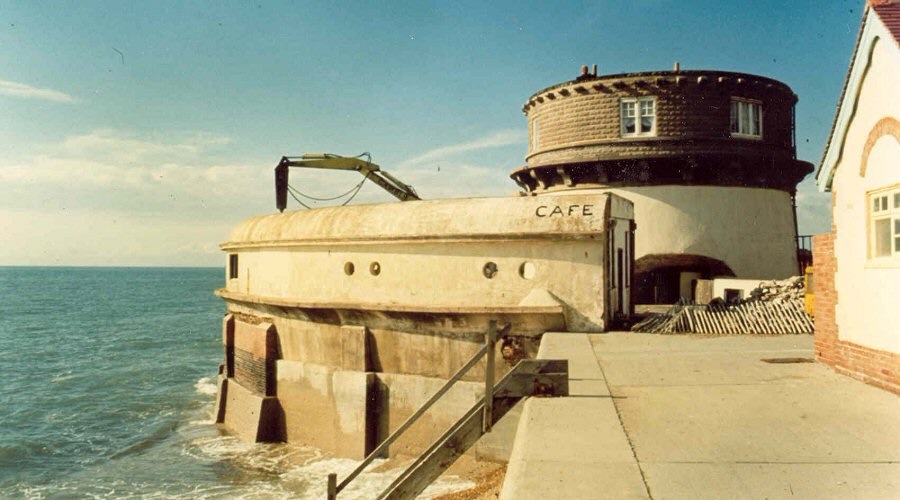
Here’s the flat being removed from the top of the Tower. Please note that there was very little beach in the late 70s and the waves reached the base of the Tower.
Beneath this Esplanade walkway lies around 6,000 sq feet of display space packed full of Seaford history and artefacts from bygone times. Put simply: ‘You name it, we’ve got it!’ From a gas-powered washing machine to the cinema projector from the Ritz cinema, a collection of neolithic handaxes found in Broad Street, a complete history of radios, televisions and music players from wax cylinders to Walkman’s. We have tableaux of an Edwardian shop, a Victorian dress makers, a Second World War era kitchen and bomb shelter and many more.
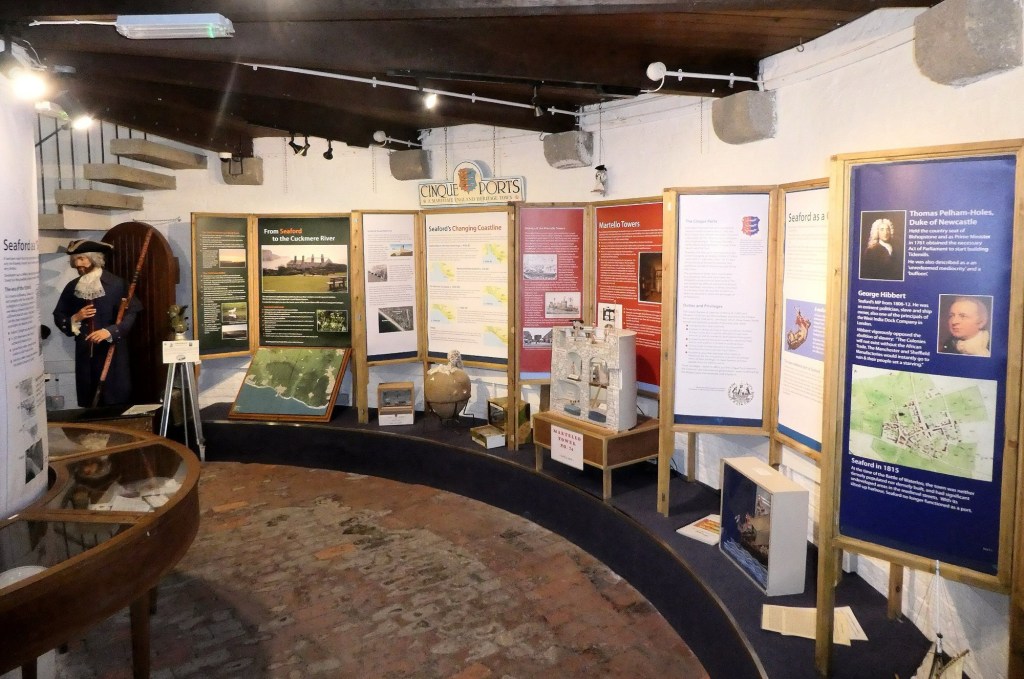
“I remember those!” Is the comment most frequently heard from visitors – whether it’s a Game Boy computer game, a slide rule or a Teasmade!
We also curate the history of Seaford with files on every street, the histories of the houses that stand there and files on local clubs. schools and associations. It’s easy to research the history of your house and road as our archive staff will be there on the first Sunday (from 1.30 pm) of each month to guide you through.
Sometimes visitors are surprised that the Museum is only open at weekends and Wednesday afternoons, but all the stewards and workers are all volunteers and there are no paid staff. Everyone is involved simply because we love it and our town
What could you contribute?
It doesn’t matter what your skills are, everyone can contribute something towards keeping the Martello Tower and the history of this very special town alive, even if you just join as a Museum Member. Email us at info@seafordmuseum.co.uk to find out more, or visit https://seafordmuseum.co.uk/

 Celebrating Seaford