
As we head into the Autumn the Seaford night skies are a battlefield of deafening cries as bats swoop and swirl, plummet and pounce at their insect prey. The acrobatic anarchy overhead goes unnoticed by us humans. Our hearing is limited and when it comes to night vision we’re as blind as, well, something with really bad eyesight… in fact anything but a bat. Bats have excellent vision. But it certainly isn’t their best sense.
Bats navigate and hunt using echolocation – an incredible superpower that allows them to ‘see’ with their ears. There are 18 species of bat in Sussex. Our smallest – the Common Pipistrelle – is also the one you’re most likely to see around your Seaford gardens. Back in the 80’s there were just four TV channels, two types of videocassette and one species of pipistrelle in Britain. But in the 90’s scientists discovered that some pipistrelles were echolocating at higher frequencies. These are the Soprano Pipistrelles.
There are larger bats over Seaford too; the Serotine whose echolocation sounds like a laid back jazz drummer and the Noctule. With a wingspan of 40cm the Noctule Britain’s biggest bat. The male Noctule is quite the ladies man, luring female bats to his harem hole in an old tree.
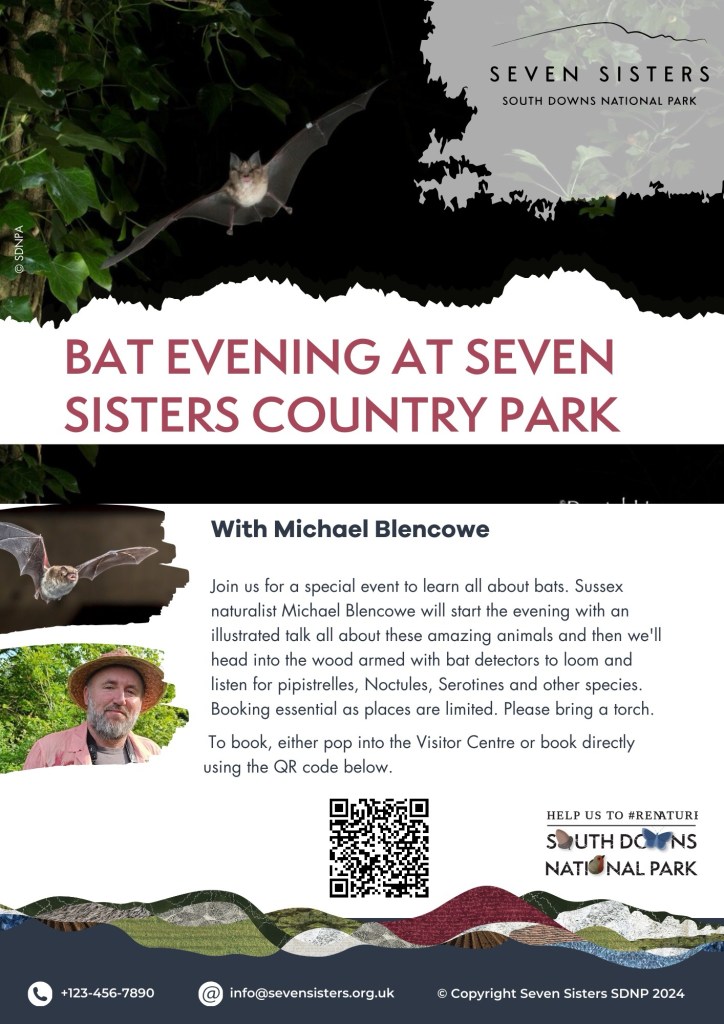
On 12 September I’ll be running a special bat evening at the Seven Sisters Visitors Centre. The evening starts with a short illustrated talk about bat evolution, ecology and identification then we’ll head out, armed with bat detectors that will let us tune in to the bat’s amazing echolocation. There are more details and booking information on the ‘What’s on’ section of the Seven Sisters website ‘What’s on’ Seven Sisters Country Park.

 Celebrating Seaford