by Rodney Castleden
Alces Place, in Firle Road, is remarkable for being a conversion twice over, first in 1920, then again in 1957. Once it was a farmyard, now it looks like a great house, a small-scale version of Ightham Mote, but it is in fact six houses.
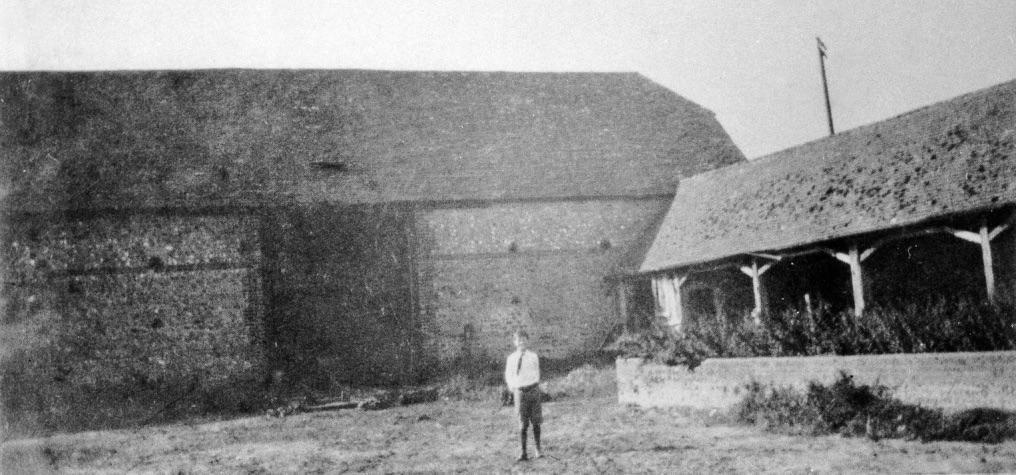
The Alces were the family who held the copyhold 1650-1774. Alces Place began as a barn, a stalled cowshed and an open-sided cartshed ranged round three sides of a square farmyard. These outbuildings lay behind the main tenant farm in the parish, Blatchington Farm. The original farmhouse is still there (Blatchington Manor care home).
Robert Lambe grew up in the farmhouse in the 1840s and 50s and
acquired Alces Place in the 1870s, but he was forced to mortgage it in 1912. The banks were becoming exasperated by Lambe’s failure to settle his debts and two years later (in July 1914) the London County and Westminster Bank sold part of the property, ‘Alces Hall’, to Bruce Ottley. This first lot consisted of ‘the dwelling house’, perhaps now No 2 Alces Place, and ‘the barn’, which Ottley spectacularly converted into a fine Arts & Crafts house (now Nos 3 & 4).
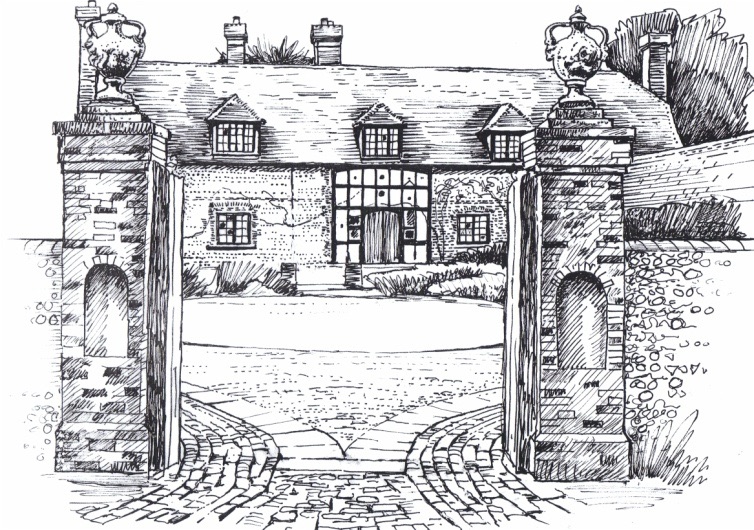
Undeterred by the First World War, in spite of being a young army officer, Ottley set about buying the rest of Alces Place in 1916. The second lot consisted of the farmyard, access to Firle Road and the field on the opposite side of the road. This separate plot to the east became the kitchen garden of what was to be a grand house. Bruce Ottley converted the old dwelling, the barn and its outbuildings into a mock-Tudor mansion. The old stone cattle trough was retained in the ornamental cobbled courtyard, as a raised flowerbed.
Bruce Ottley was 24 when he bought the property. Later he worked as a banker in the City and had a flat in Seymour Street, W1. He was a gifted pianist and arts administrator too, chairing the management board of the Covent Garden Opera House and helping to found the Bath Festival. His Seaford connection was the parental home, The Chalet, which stood in Steyne Road opposite the junction with Crouch Lane. Evidently Bruce liked Seaford and wanted a weekend home there, a place where he could relax with family (he married in 1923) and have weekend house parties.
He commissioned his Arts & Crafts make-over from the London architect Montague Wheeler. In 1923, Country Life presented the finished house as a barn conversion, emphasizing the ordinariness of the original buildings, and the way Wheeler’s design ‘transformed [them] into something very pleasing indeed.’
In 1938 Bruce decided to let Alces Place, ‘a charming PERIOD HOUSE with 9 principal bed rooms, 4 bath, 4 reception, garage, tennis court, moderate rent.’ It also had a swimming pool, squash court and fine gardens.
The tenant was Commander Dunderdale, the high-powered intelligence officer who headed Paris station for SIS (now MI6), and who would shortly run half of the French Resistance by radio from Alces Place. When creating James Bond, Ian Fleming drew on Biffy Dunderdale’s exploits and his glamorous life-style. Dunderdale bought the property in 1948, following Bruce Ottley’s death. Then, in 1956, Dunderdale moved to America, and the developer Bertram Adams commissioned his architect, Roy Clare, to redesign the conversion into 6 dwellings.
Three architectural schemes are embedded in Alces Place: a traditional Sussex farmyard dating from the seventeenth century, an Arts & Crafts barn conversion designed by Montague Wheeler, and a conversion to multiple occupancy designed by Roy Clare. The end result is marvellous.
It remains one of the finest buildings in East Blatchington, with a distinctive history as well as colourful and distinguished residents.

 Celebrating Seaford