We are blessed to live in such a beautiful town. One that is full of green and open spaces, surrounded by either the South Downs National Park or the sea.
We have the opportunity to celebrate the wonderful flora and fauna all around us, in our gardens, on the grass verges, the green and open spaces in the town and on the Downs or seafront.
Everyone, young and old, has the chance to become a ‘Citizen Scientist’ to help with research and conservation of the biodiversity surrounding us.
Don’t worry you don’t have to be an expert! If you have a smartphone you can download apps that will identify the flora and fauna. There is even an app that will listen to the bird song and tell you which birds are close by. (I have recorded 38 different birds in my garden!).
If you report your findings to the Sussex Biodiversity Record Centre they will be able to use the information to help with nature conservation, planning, research and education. Every sighting will be recorded on a map.
Let’s work together to show how special Seaford is and flood the map with our wildlife sightings and recordings. Henfield in West Sussex have declared 2024 the year of biodiversity and have already recorded over 700 different species!
How can you help?
I warn you once you start it becomes addictive.
There are three apps I have tried. They were recommended by wildlife expert Michael Blencowe.
Merlin Bird ID. – This free app was created by the Cornell Lab of Ornithology. You press record, the app listens for bird song. It lists all of the birds it hears and gives you the opportunity to click on a picture of a bird identified and read all about it. When you identify the birds you can log your findings with the Sussex Biodiversity Centre using iRecord (see below).
Seek by iNaturalist – this free app is ideal for children to get involved in discovering the natural world around them. It gives them a chance to identify the flora and fauna around while completing challenges and collecting badges. There is no need to create an account and no identifiable data is collected unless you want to send your sightings to iNaturalist. However, observations are saved to your phone so can be added manually to iRecord to ensure the Sussex Biodiversity Record Centre has a record of the biodiversity in Seaford.
When you select the camera on Seek and point it at a living thing it will give you an initial identification. There are green dots on the screen, once all 7 are lit up you can take your photograph and get a species identification. If you can’t get all of the lights to show you can still take a photo and the app will give you pictures of the closest options for you to select what you found. Further information is displayed on the species you have identified helping you to learn more about the biodiversity around.
There are plenty of challenges for children to complete, with badges awarded as they progress. The challenges are designed to give children a greater understanding of the natural world.
iNaturalist – this free app allows you to take a photograph of the animal or plant and will suggest the most likely identification. Your photos will be checked by other people and once verified by 3 different individuals will be submitted for scientific research. If local schools or youth groups want to get involved there is a Teacher’s Guide on the iNaturalist webpage to help you. Anything recorded on iNaturalist will automatically be uploanded to iRecord. I have found records on this app are verified very quickly, sometimes within hours of the record being uploaded.
iRecord – This app also allows you to take photographs of animals or plants and will again suggest the most likely identification. The Sussex Biodiversity Record Centre adopted iRecord as one of it’s main conduits for Sussex sightings data. As Merlin Bird ID does not automatically transfer your recordings to iRecord you will need to log them yourself. When doing this it helps if you enter in the comments field you used Merlin Bird ID as it will assist the verifiers confirm your findings.
If you don’t have a smartphone you can take a photograph with a camera and upload the picture to iNaturalist for identification.
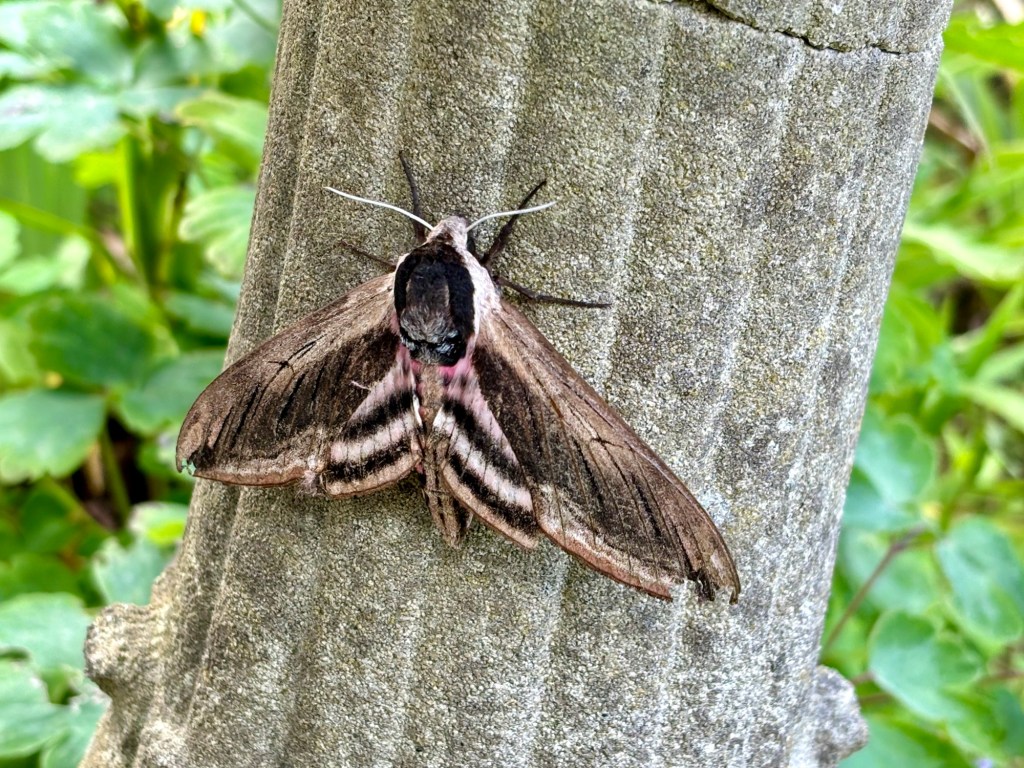
There was a photo recently on Seaford Facebook of a Privet Hawk Moth seen in Seaford. These are the largest hawk moths in the UK, I think I’ll duck if one flies towards me!
Also did you know there are around 270 species of bee in the UK? The Potter bee is one of the rarest bees in the UK. Seaford Head is one of only 3 places in the UK where this bee can be found. I’ve seen a hairy footed flower bee, and a buff tailed bumble bee but I haven’t seen the elusive Potter bee yet.
If you choose to become a ‘Citizen Scientist’ not only will you be helping with nature conservation and research, but it is well documented that getting out in nature helps improve both your physical and mental health.
Please share this article with friends, family and Facebook to hopefully recruit more ‘Citizen Scientists’ and help with nature conservation in Seaford.

 Celebrating Seaford